
1. The EU-Mercosur Agreement
The European Union-Mercosur Agreement entered into force on May 1, 2026, following negotiations that began in 2000 and unfolded over more than two decades.
It marks an important step toward deeper economic integration between Europe and South America. The Agreement is expected to strengthen trade flows, expand investment opportunities, and foster long-term commercial cooperation between the two regions.
Against this background, Brazil occupies a particularly strategic position, given the size of its economy, its industrial capacity, and its role as a regional hub for business operations in Latin America.
2. Why Brazil matters economically
Brazil is the largest economy in Latin America, with more than 200 million inhabitants and a GDP of approximately US$ 2.6 trillion.
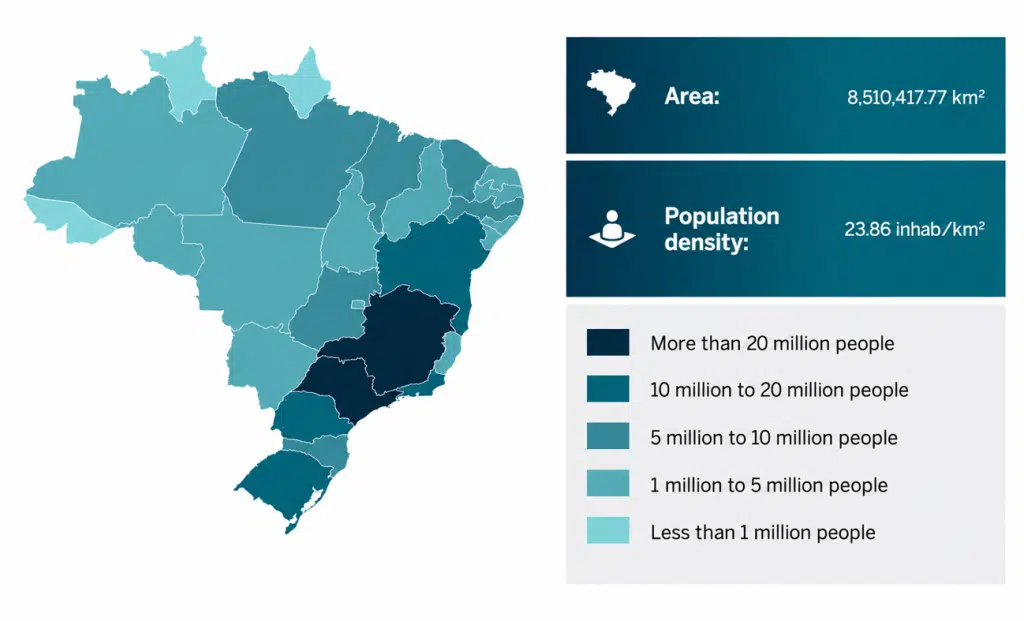
It is also one of the world’s largest consumer markets, importing more than US$ 280 billion annually. The European Union is currently Brazil’s second-largest trading partner.
Brazil offers significant opportunities in sectors such as infrastructure, agribusiness, energy, technology, healthcare, and industrial production. Historically, the country has maintained an open stance toward foreign investment, which has contributed to the development of several strategic sectors.
Brazil continues to face important economic and social challenges. Yet those structural demands also create investment opportunities, particularly in infrastructure, energy, technology, and industrial development. Combined with its large domestic market and strong industrial base, these factors support the country’s long-term growth potential.
3. The Brazilian legal environment
Brazilian law has been strongly influenced by European legal traditions. The country is party to international treaties and conventions, contributing to a sophisticated and internationally connected legal framework.
Brazil has a professional and highly institutionalized judicial system, with constitutional guarantees protecting private property, contractual stability and due process of law.
The country also has extensive experience with arbitration, particularly following the enactment of the Arbitration Act of 1996. Over the last decades, arbitration has become a highly sophisticated and reliable mechanism for resolving complex commercial, corporate and infrastructure disputes, especially in large scale and high value transactions involving technical, regulatory or long term contractual issues.
Doing business in Brazil nevertheless requires careful attention to regulatory complexity. Brazil is a federation in which legislative and administrative powers are distributed among the Federal Government, States and Municipalities. In addition, the Brazilian tax system is both complex and decentralized, making specialized legal and tax advice particularly important for foreign investors.
4. How foreign companies can enter the Brazilian market
As a general rule, Brazilian law allows foreign investment under the same conditions applicable to domestic companies. There are specific restrictions in limited sectors, particularly involving national security and rural land ownership, but the Brazilian economy is broadly open to international capital.
In practical terms, there are two principal ways for foreign companies to enter the Brazilian market.
The most immediate alternative is exporting products to Brazil, either directly or through local distributors and trading companies. This model allows foreign companies to establish a commercial presence with relatively limited risk and lower initial investment.
In these cases, the main legal issues generally involve commercial contracts, customs regulation and taxation. The EU-Mercosur Agreement is expected to progressively reduce tariffs in several sectors, facilitating access for European products to South American markets.
A second option is establishing a Brazilian subsidiary under Brazilian law, allowing a more permanent and structured presence in the country. The most common corporate structures are corporations (“Sociedades Anônimas” or S.A.) and limited liability companies (“Sociedades Limitadas” or Ltda.).
Foreign companies may also operate directly in Brazil after obtaining authorization from the Federal Government and appointing a local legal representative.
5. Private contracts and public contracts
Private contracts in Brazil are generally governed by the principle of freedom of contract, allowing broad autonomy for negotiating commercial terms, rights and obligations. Certain sectors, however, are subject to more intensive regulation, including energy, telecommunications, pharmaceuticals and infrastructure.
Public contracts follow a distinct legal framework. Except in specific situations provided by law, the Government and state owned companies must conduct public procurement procedures when acquiring goods, contracting services or carrying out public works. Public procurement represents approximately 16% of Brazil’s GDP, corresponding to roughly US$ 200 billion annually.
Brazilian procurement legislation allows the participation of foreign companies and prohibits discrimination based on nationality or domicile. In addition, the EU-Mercosur Agreement contains a specific chapter dedicated to public procurement, reinforcing principles of equal treatment and non discrimination based on the origin of the bidder. This framework creates relevant opportunities for international companies interested in entering the Brazilian public sector market, particularly in infrastructure and regulated industries.
6. Conclusion
Brazil can certainly be a complex jurisdiction. Successful operations generally require local expertise, especially regarding regulatory matters, taxation and accounting.
At the same time, Brazil combines economic scale, institutional sophistication and considerable market opportunities. For well-prepared foreign investors, it remains one of the most relevant and promising markets in South America.
